
22 Passenger Bus for Sale: One Big Bus or Two Smaller Ones?
If you are shopping for a 22 passenger bus for sale, ask one question before you compare prices: do you need one large bus, or would two smaller shuttles serve you better? On our lot today, one large bus costs far less to buy and needs only one driver, but that driver must hold a commercial driver's license (CDL). Two non-CDL shuttles cost more up front, yet they are easier to staff and can run two routes at once.
This guide walks through the trade-offs with real prices. For sizes and layouts, see our 22 passenger buses and 24 passenger buses pages, or browse all of our reconditioned buses for sale.
Start With the Price Difference
Here is how the two approaches compare, using reconditioned buses we have for sale right now.
- Buses: one 2018 Ford F-550 Glaval 28/2, or two 2018 Ford E-350 Diamond Coach 13/2
- Total price: $65,990 for the one large bus, or $119,980 for the two matched shuttles ($59,990 each)
- Most passengers: 28 on the large bus, or 26 on the pair (13 per bus)
- With wheelchairs aboard: 24 passengers plus 2 wheelchairs on the large bus, or 22 passengers plus 4 wheelchairs on the pair (11 plus 2 per bus)
- Drivers needed: 1, with a CDL, for the large bus, or 2, no CDL under federal rules, for the pair
- Miles: 104,000 on the large bus, or 42,759 and 50,440 on the pair
Seats fold up to make room for wheelchairs, so each bus carries fewer passengers when wheelchairs are aboard. The driver is not counted in any of these numbers.
The single bus saves $53,990 on the purchase price. The pair has far fewer miles, though, and it gives you a backup: if one bus is in the shop, the other keeps running. Two buses also mean two insurance policies, two registrations and two maintenance schedules, so get quotes for both setups before you decide.
The Driver Question Usually Decides It
Federal rules treat a vehicle designed to carry 16 or more people, including the driver, as a commercial motor vehicle. A 22 passenger bus is over that line. A 13-passenger shuttle is under it, although some states add their own rules. Our state-by-state buyer's guide is a good place to start, and our post on non-CDL shuttle bus capacity explains how seats are counted.
Before you choose the larger bus, count what the CDL means for your organization:
- License group. A bus rated at 26,001 pounds GVWR or more falls in Group B. A lighter bus designed for 16 or more people falls in Group C. Check the rating on the exact bus you are considering.
- Passenger endorsement. Drivers need a passenger endorsement, which takes a knowledge test and a skills test in a passenger vehicle of the right group.
- Training. Since February 7, 2022, first-time passenger endorsement applicants must complete entry-level training from a provider on FMCSA's Training Provider Registry.
- Drug and alcohol testing. FMCSA's testing rules cover CDL drivers, including part-time, intermittent and backup drivers. The program includes pre-employment and random testing.
If you already employ a CDL driver, the larger bus gets much simpler. Plan for a backup, though, because the bus stays parked when your only qualified driver is out. If your drivers are volunteers or staff who drive now and then, ask your insurer and your state licensing agency what applies to you before you buy.
Let Your Routes Break the Tie
Once you know your driver situation, look at how your riders actually move.
One larger bus usually fits when:
- Your whole group travels together to one place, such as a church trip, a tour or a shift change
- You already have a CDL driver, or a clear plan to hire or train one
- You have room to park and turn a longer vehicle
- Keeping the purchase price down matters most
Two smaller shuttles usually fit when:
- Riders need to go in different directions at the same time
- Your drivers do not hold a CDL
- You cannot afford to lose all service when one bus is down
- You carry several wheelchair riders and want a lift on each bus
If you are also weighing chassis sizes, our Ford E-450 vs F-550 comparison covers how the two differ.
22 Passenger Bus for Sale: Reconditioned Options Available Now
We do not have a bus with exactly 22 seats on the lot today. These three reconditioned buses cover the same need from different directions, and we source buses nationwide if you want a specific layout. See more on our 22 passenger and 24 passenger pages.
2018 Ford F-550 Glaval 28/2 Wheelchair Shuttle Bus

This Ford F-550 Glaval has the 6.8L V10 gas engine, an automatic transmission and 104,000 miles. Seating: up to 28 passengers, or 24 passengers plus 2 wheelchairs (seats fold up), plus driver. It has a commercial wheelchair lift, front and rear A/C, rear passenger heat, an electric passenger door, a backup camera and a high roof. At this size, plan on a CDL driver with a passenger endorsement. Price: $65,990. View the listing
2018 Ford E-350 Diamond Coach Non-CDL 13/2 Wheelchair Shuttle Bus
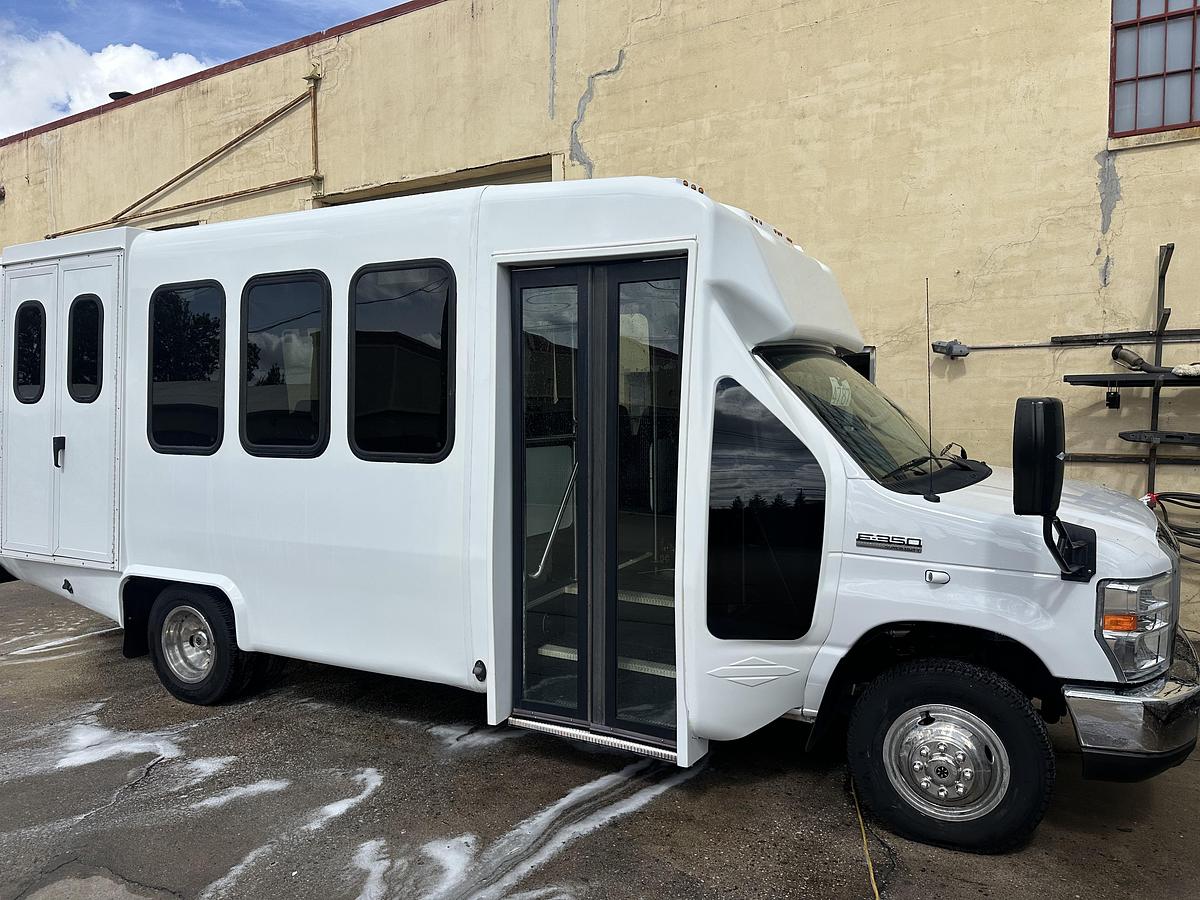
This Diamond Coach E-350 has the 6.8L V10 gas engine, an automatic transmission and 42,759 miles. Seating: up to 13 passengers, or 11 passengers plus 2 wheelchairs (seats fold up), plus driver. The wheelchair lift sits at the right rear, curb side, and the bus has passenger seatbelts and front and rear climate control. Its matched mate has the same layout and price with 50,440 miles, so you can buy the pair. Price: $59,990 each. View the listing
2017 Ford E-450 16/2 Wheelchair Shuttle Bus

If 16 seats will do, this one-owner E-450 is the lowest-priced bus of the three. It has the 6.8L V10 gas engine, an automatic transmission and 96,500 miles. Seating: up to 16 passengers, or 12 passengers plus 2 wheelchairs (seats fold up), plus driver. It has a remote-controlled BraunAbility wheelchair lift, Q'Straint retractors, dual A/C with rear heat, and a backup camera with sensors. With 16 passengers plus the driver, it requires a CDL with a passenger endorsement. Price: $34,000. View the listing
Frequently Asked Questions
Do I need a CDL to drive a 22 passenger bus? Yes. Federal rules require a CDL for a vehicle designed to carry 16 or more people, including the driver, and the driver also needs a passenger endorsement.
Is one 22 passenger bus cheaper than two smaller shuttles? Usually, on purchase price. On our lot today, a 28/2 F-550 is $65,990 and a matched pair of 13/2 E-350s is $119,980. Compare miles, insurance and driver costs too, because the pair has far fewer miles and does not need CDL drivers under federal rules.
Can a bus this size carry wheelchairs? Yes, when it has a lift and fold-up seats. Our 2018 F-550 Glaval seats up to 28 passengers, or 24 passengers plus 2 wheelchairs, plus driver.
Talk It Through With Us
Tell us how many riders you carry, how many wheelchairs, who will drive and where you are, and we will help you work out whether one bus or two makes more sense. Call or text (516) 852-2748, Monday to Friday 9 to 5, or send us a message online any time. We offer FaceTime walkarounds, financing and delivery anywhere in the U.S. Browse all of our buses for sale.
Sources
- 49 CFR 383.5, Definitions (commercial motor vehicle), Legal Information Institute
- 49 CFR 383.91, Commercial motor vehicle groups, eCFR
- 49 CFR 383.93, Endorsements, Legal Information Institute
- 49 CFR 383.117, Requirements for passenger endorsement, regulation text
- Training Provider Registry: driver FAQs, FMCSA
- Who do I test?, FMCSA