
Do You Need a CDL to Drive a Shuttle Bus? CDL, USDOT and Insurance Rules Explained
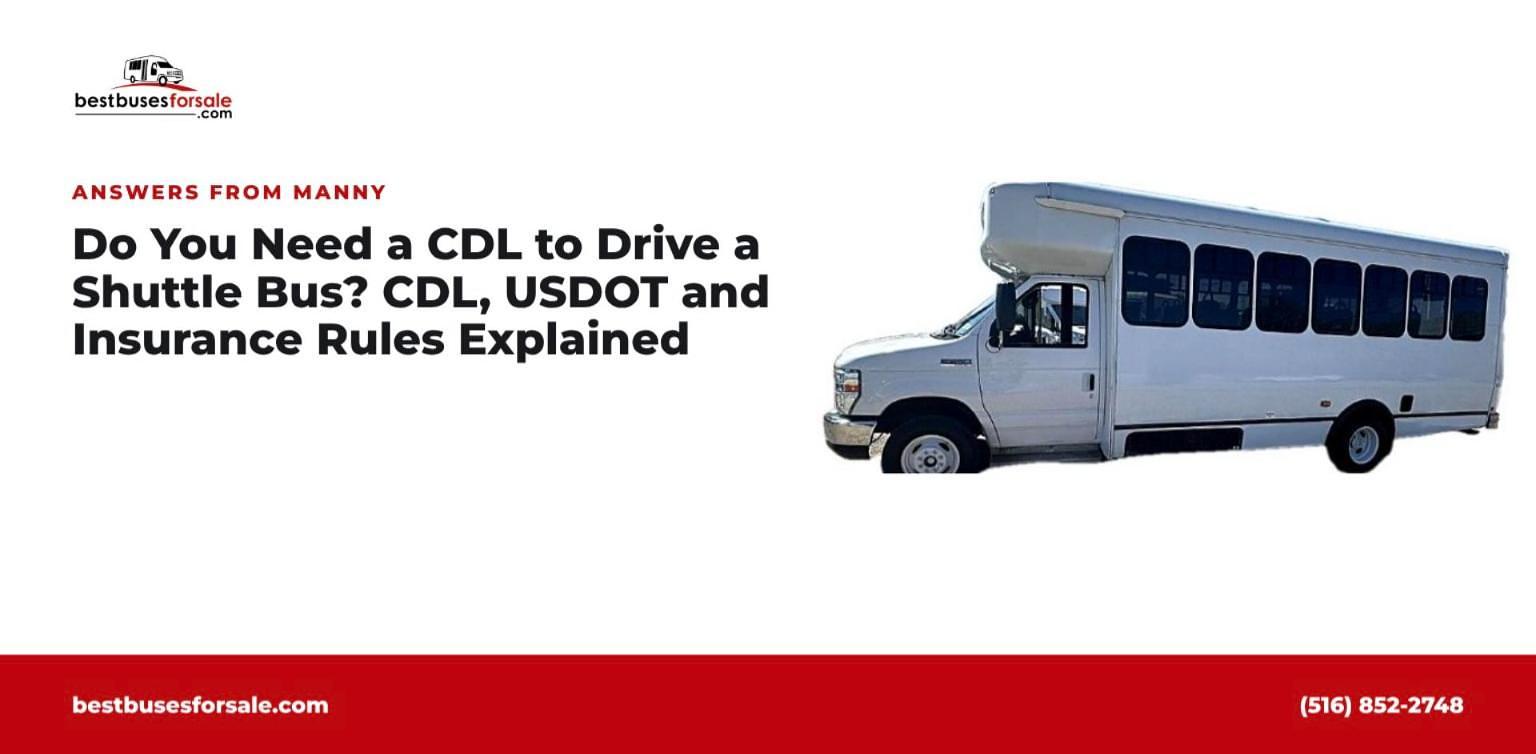
The first question nearly every buyer asks me is whether their drivers will need a commercial license. The answer decides which buses you can consider at all, so it deserves a careful reply. Below are the licensing and compliance questions we hear most, answered plainly and checked against the federal sources listed at the end.
Do I Need a CDL to Drive a Shuttle Bus?
Under federal rules a driver needs a CDL with a passenger endorsement when the bus is designed to carry 16 or more people counting the driver, or when it is rated over 26,000 lb. So a bus with 15 passenger seats plus the driver's seat needs a CDL. A bus with 14 or fewer passenger seats on an E-350 or E-450 usually doesn't. FMCSA counts designated seats only, not standing room. States can add their own rules for church, school or for-hire drivers, so check your state too.
Manny's take: Don't buy a 15-passenger bus planning to pull a seat to slip under the line. Get your state DMV's answer in writing first, and if your drivers don't hold CDLs, buy a bus that never needed one.
More: State Buyer's Guide
Do I Need a USDOT Number?
You need one if you cross state lines and the bus is built or used to carry 16 or more people counting the driver, or 9 to 15 people for pay. Pay can be direct or built into what you charge, like a hotel or employer shuttle. FMCSA's rules can also reach private operators that don't charge riders, depending on the bus's size and weight. Run FMCSA's "Do I need a USDOT number?" check before your first out-of-state trip. Trips that stay in one state follow that state's rules.
Can a Church, Camp or Daycare Carry Children in a Used Shuttle Bus?
Federal school bus rules control the sale of new vehicles. A new bus or van for 11 or more people that will be used significantly to take students to or from school or school events has to meet school bus standards. NHTSA's rules don't forbid selling or using used vehicles for that, but many states have their own pupil-transport rules, and your insurer will have opinions too. For regular school runs, ask your state's pupil transportation office. For church outings, camps and activities, a well-kept shuttle bus with trained drivers and seat belts where fitted is common.
More: church buses for sale
How Much Insurance Do I Need, and What Will It Cost?
For-hire carriers crossing state lines must carry at least $1.5 million for vehicles that seat 15 or fewer counting the driver, and $5 million for 16 or more. Churches and private fleets set their own limits with their agent, and many church insurers require a written driver policy. Prices depend on your drivers, your use, where the bus is kept and the bus itself, so there's no honest one-size number. Get a quote on the actual VIN before you buy. A surprise premium is the most common reason a bus deal falls apart late.
More: bus insurance page
What Paperwork Comes with a Used Bus?
At minimum: the title signed over correctly, a bill of sale with the VIN, price, date and both signatures, and an odometer disclosure where it's required. Federal odometer disclosure applies to model year 2011 and newer vehicles for 20 years. Buses rated over 16,000 lb are exempt, but most E-350 and E-450 shuttle buses are rated below that, so plan on it. Ask for any service records, the lift's manual and inspection history, and the keys and fobs.
Manny's take: We don't buy or sell a bus without a clean title in hand, front and back. It is the one rule in this business I have never bent.
Which of These Records Does the DOT Actually Require?
It depends on how you operate. Carriers running 9-to-15-passenger buses for indirect pay (hotel, employer and similar shuttles) across state lines must register, mark the bus with the USDOT number and keep an accident register. Larger and for-hire operations take on more: driver files, inspections and maintenance records. Even where nothing is required, written pre-trips, lift logs and maintenance records protect you with insurers and in court, and they raise the bus's value when you sell.
Have another question? We answer 42 of them in Shuttle Bus Questions, Answered.
Go Further
The full answers, worksheets and checklists are in our guides at the Best Buses Store: Buy the Right Bus for buyers, Sell Your Bus Right for sellers, plus the Church Bus Buying Kit and the Wheelchair Bus Owner's Guide. Looking for a particular bus? Tell us on Find Me a Bus. Selling one? Start at Sell Us Your Bus.
About the Author
Manny Casamassima is President of Best Buses For Sale, a family-run shuttle and wheelchair bus dealership in Huntington, New York. His family has been in transportation and logistics for decades. He buys buses nationwide, mostly from outside the Rust Belt, drives every one himself and brings them home on the company's own flatbeds. Questions about a bus, yours or ours, are always welcome through the contact page or at (516) 852-2748.
Sources
Rules and figures above were checked in November 2026 against these sources. Rules change and states add their own, so confirm anything that decides a purchase; this is plain-language guidance, not legal or tax advice.
- FMCSA: Passenger Carrier Guidance Fact Sheet
- FMCSA guidance: "designed to transport" counts designated seats only (49 CFR 383.5)
- FMCSA: Passenger carrier, do I need a USDOT number?
- FMCSA: Small passenger-carrying vehicles (9 to 15 passengers)
- NHTSA: school bus and 15-passenger van rules
- 49 CFR 580.17: odometer disclosure exemptions
- NHTSA: odometer disclosure now 20 years for 2011 and newer