
Shuttle Buses for Senior Living and Assisted Living Communities: A Buyer's Guide
The right senior living shuttle bus is one your residents can board easily, your staff can drive with the license they already hold, and your wheelchair users can ride on the same trip as everyone else. For most senior living and assisted living communities, that means a lift-equipped Ford E-350 or E-450 with seats that fold up to make room for wheelchairs. Below we cover how to size the bus, who can drive it, what to check before you buy, and three reconditioned buses on our lot right now. You can also browse our full inventory.
Start With Your Weekly Trip List
Before you look at a single bus, write down the trips your community runs in a normal week: doctor and dialysis appointments, grocery and pharmacy runs, worship services, lunch outings, shows and day trips. For each one, note the biggest group that goes and how many of those riders use a wheelchair or scooter.
Size the bus for your biggest regular trip, not the once-a-year outing. A bus that sits half empty five days a week costs more to fuel and is harder to park at a clinic. If one trip a month needs more seats, it is often cheaper to run two loops or rent for that day.
Also think about who rides next year. If more of your residents are moving from walkers to wheelchairs, a layout with extra wheelchair positions may save you from replacing the bus early.
How Seating and Wheelchair Positions Work
Shuttle bus listings use shorthand like 13/2 or 16/6. The first number is the most passengers it seats, the second the most wheelchair positions, and seats fold up for wheelchairs so it carries fewer passengers when wheelchairs are aboard.
For example, a 16/6 bus carries up to 16 passengers, or 10 passengers plus 6 wheelchairs (seats fold up), plus driver. A 13/2 bus carries up to 13 passengers, or 11 passengers plus 2 wheelchairs (seats fold up), plus driver. So the question to ask is not "how many seats?" but "on our busiest trip, how many riders sit and how many stay in their chairs?"
CDL or Non-CDL: Who Will Drive Your Senior Living Shuttle Bus?
This is the question that decides more purchases than any other. Under federal rules, a driver needs a commercial driver's license (CDL) for a vehicle designed to carry 16 or more passengers, including the driver, or one over 26,000 pounds gross vehicle weight rating (49 CFR 383.5). FMCSA counts designated seats, not standing room, when it applies that rule (FMCSA guidance). A bus that seats 16 passengers plus the driver is a 17-seat vehicle, so your driver needs a CDL with a passenger endorsement.
If your drivers are activities staff or maintenance staff with a regular license, look for a non-CDL bus that seats 15 or fewer passengers plus the driver, such as a 13/2 E-350. States can add their own rules, so check with your state's motor vehicle agency too. Our post on non-CDL shuttle bus capacity goes deeper on the numbers.
If your community has a CDL driver on staff, a 16-passenger E-450 gives you more room for the same kind of trips.
What Makes a Bus Easy for Older Riders
A bus for seniors is judged at the door and in the aisle. Here is what we suggest checking on any bus you consider:
- The wheelchair lift. A name-brand lift such as Braun or BraunAbility is easier to service and find parts for. Run it up and down several times, and check the handrails, platform and safety barriers. Our wheelchair lift inspection checklist walks through it step by step.
- Wheelchair securement. Every wheelchair position needs its own tie-downs, such as Q'Straint retractors or floor-track straps. Count them, and make sure staff know how to use them.
- Grab rails and a clear aisle. Overhead grab rails and an open aisle help riders who walk with a cane or need a steady hand.
- Front and rear climate control. Older riders feel heat and cold more. A bus with rear A/C and heat keeps the back of the bus comfortable, not just the driver.
- Driver aids. A backup camera makes tight drop-off loops and clinic parking lots easier.
On accessibility rules: a senior living community that runs its own shuttle is generally treated as a private entity not primarily in the business of transporting people under the U.S. Department of Transportation's ADA rules. If it runs an on-call or scheduled-by-request shuttle, the service, viewed as a whole, must be equivalent for riders with disabilities (49 CFR 37.171). A lift-equipped bus is the simplest way to meet that. Ask your attorney or compliance team how the rules apply to your community.
Why Reconditioned Makes Sense for a Community Budget
Many communities buy one bus and run it for years, so the price and the condition both matter. Wheelchair-accessible buses on our lot currently range from $21,990 to $76,990, depending on size, year, mileage and layout.
We source rust-free buses nationwide, recondition them, and test the lift and drive every bus before it goes out. We can do a live FaceTime walkaround so your director or board can see the bus before you commit, we offer financing, and we deliver anywhere in the U.S.
Senior Living Shuttle Buses for Sale Now
These three reconditioned buses fit the needs most senior living and assisted living communities describe to us.
2017 Ford E-450 16/2 Wheelchair Shuttle Bus: $34,000

Up to 16 passengers, or 12 passengers plus 2 wheelchair positions (4 seats fold up), plus driver. This one-owner, clean-title E-450 has 96,500 miles, a 6.8L Triton V10 gas engine and an automatic transmission. It has a remote-controlled BraunAbility wheelchair lift, Q'Straint retractors, high-back seats, dual A/C, a backup camera and sensors, heated mirrors and a roof escape hatch. It needs a CDL driver with a passenger endorsement, so it suits communities that already have one on staff. See the 2017 E-450 16/2 listing.
2018 Ford E-350 Diamond Coach Non-CDL 13/2 Wheelchair Shuttle Bus: $59,990
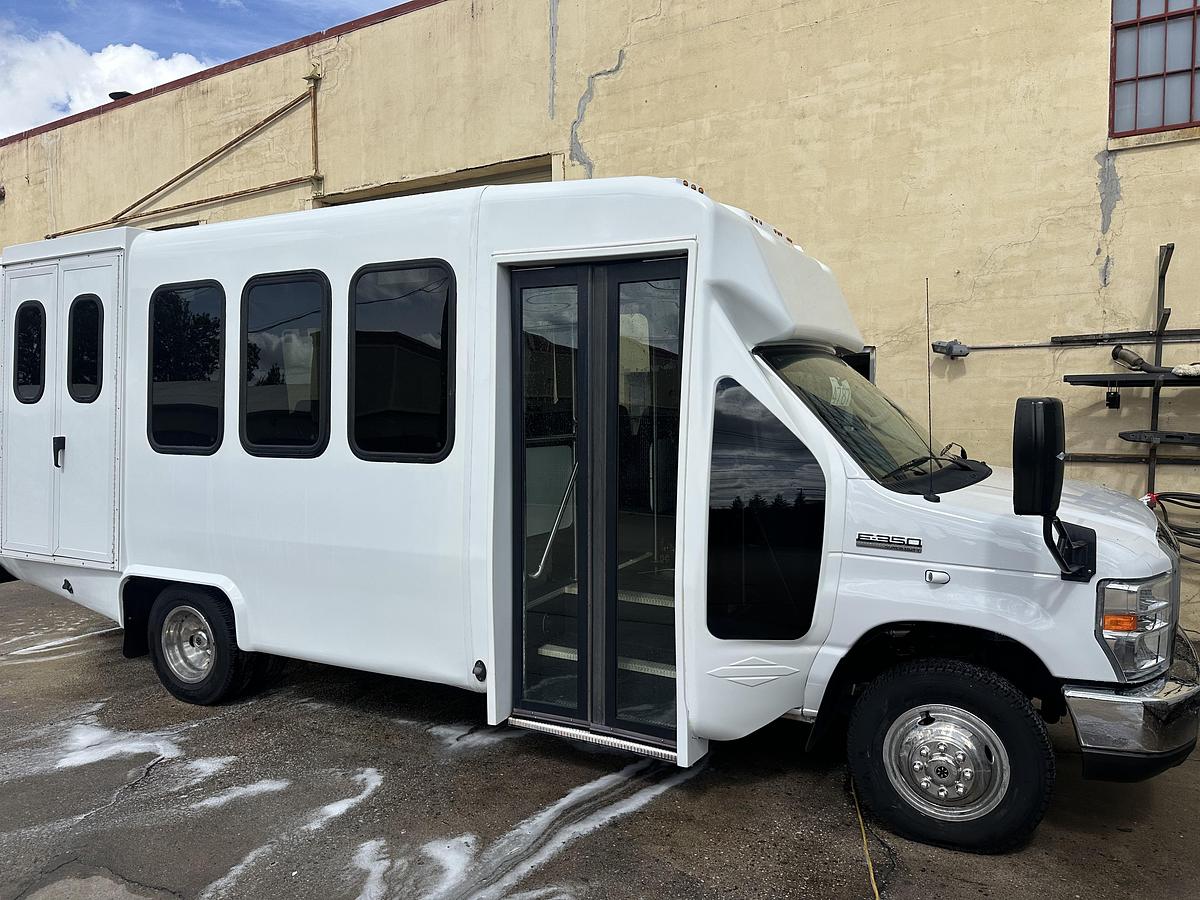
Up to 13 passengers, or 11 passengers plus 2 wheelchairs (2 seats fold up), plus driver. This non-CDL E-350 has 42,759 miles and a 6.8L V10 gas engine, and spent its life in the South, outside the salt belt. Perimeter seating leaves an open center aisle with overhead grab rails, and it has passenger seatbelts, a wheelchair lift, floor-track tie-downs and front and rear climate control. A matching bus is also available if you need two. See the 2018 E-350 13/2 listing.
2018 Ford E-450 16/6 Wheelchair Bus: $60,000

Up to 16 passengers, or 10 passengers plus 6 wheelchair positions (6 seats fold up), plus driver. For communities with many residents in wheelchairs, this fleet-maintained E-450 has a Braun wheelchair lift, Q'Straint securement, front and rear A/C and rear heat. It has 104,000 miles and a 6.8L V10 gas engine, and it requires a CDL driver. It just arrived and is in our reconditioning program, so you can buy it as-is, partly reconditioned or fully reconditioned. See the 2018 E-450 16/6 listing.
Frequently Asked Questions
What size shuttle bus does a senior living community need? Size it for your biggest regular trip. Count how many residents ride on that trip and how many stay in wheelchairs, then pick a layout that fits both. Many communities land on a 13/2 non-CDL bus or a 16-passenger E-450.
Do our drivers need a CDL? A bus designed for 16 or more people, counting the driver, needs a CDL driver under federal rules. A bus that seats 15 or fewer passengers plus the driver, and stays under 26,001 pounds GVWR, can be driven on a regular license in most cases. Check your state's rules too.
Can you deliver a bus to our community? Yes. We deliver anywhere in the U.S., and we can show you the bus first on a live FaceTime walkaround.
Find the Right Bus for Your Residents
Tell us about your trips and your riders, and we will match you with the right reconditioned bus. Call or text (516) 852-2748, Monday through Friday 9 to 5, or send us a message any time. We offer FaceTime walkarounds, financing and nationwide delivery. See all reconditioned shuttle buses for sale.
Sources
- FMCSA: One definition of a CMV, vehicle designed to transport 16 or more passengers
- 49 CFR 383.5, Definitions (commercial motor vehicle)
- 49 CFR 37.171, Equivalency requirement for demand responsive service operated by private entities not primarily engaged in the business of transporting people