
What to Inspect on a Used Wheelchair Lift Before You Buy
If you're shopping for a used shuttle bus for sale with a wheelchair lift, the lift deserves its own inspection, separate from the engine and body. Cycle it at least three full times, test every safety interlock, check the hydraulics and the emergency manual backup, and get the lift's maker and serial number so you can ask about service history and recalls. A lift that fails these checks can take a bus out of service the day you need it.
Below is a lift walkaround any church administrator, NEMT owner or transit coordinator can run, in person or over FaceTime. For the rest of the bus, see our post on why we recommend an inspection before buying a used shuttle bus.
Start With the Paperwork on the Lift
Commercial shuttle buses commonly use a platform lift from Braun (BraunAbility) or Ricon. Each lift has its own data plate with a manufacturer, model and serial number, separate from the bus VIN. Write those down before you look at anything else.
Vehicle lifts fall under federal safety standards: FMVSS 403 covers the lift and FMVSS 404 covers its installation. The lift maker must certify compliance and supply owner's manual inserts with operating instructions. Ask the seller for that manual and any lift service records. With the serial number, a mobility dealer can check open recalls and parts availability. Also run the bus VIN through NHTSA's recall lookup.
Cycle the Lift Three Full Times
Run the lift from stowed, out, down to the ground, back up to floor level, and stowed again. Do it at least three times, and once with a person or a weighted load on the platform if the seller allows. Watch and listen for:
- Smooth, steady motion. Jerking, hesitation or a platform that drifts down on its own points to hydraulic or valve problems.
- Reasonable speed. The federal ADA vehicle standard caps occupied platform movement at 6 inches per second, and deploy or stow at 12 inches per second. A lift that slams or races is not right.
- Level platform. The platform should sit level with the bus floor at the top and flat on the ground at the bottom, without a gap or lip that catches the front wheels of a chair.
- Quiet pump. Grinding, whining or a pump that runs long after the lift stops all deserve a closer look.
Test Every Interlock and Safety Feature
Interlocks are easy to overlook. Under the ADA vehicle standard in 49 CFR 38.23, lift controls must be interlocked with the brakes, transmission or door so the bus can't move while the lift is out, and the lift can't deploy unless those interlocks are engaged. Check them yourself:
- With the lift stowed, take the bus out of park. The lift should refuse to deploy.
- With the lift deployed, try to shift out of park. The bus should not move.
- Let go of the pendant buttons mid-cycle. The controls must be momentary-contact, so the platform should stop as soon as you release.
- Raise an occupied platform more than 3 inches off the ground. The outer roll-stop barrier should be up and locked.
- Check the side barriers and both handrails. The handrails should move with the platform and feel solid, not wobbly.
A failed interlock is often just a switch or sensor, but fix it before the bus carries riders.
Check Hydraulics, Wiring and the Manual Backup
Open the pump cover and look at the hydraulic fluid level and color. Fluid should be at the mark and clean, not milky or dark. Look for wet spots on hoses, fittings and cylinders, and for drips under the bus where the lift sits.
Follow the wiring from the pump to the pendant control. Cracked insulation, taped splices and loose connectors cause intermittent failures that are hard to track down.
Then find the manual backup. The ADA standard requires an emergency way to deploy the lift, lower an occupied platform to the ground and stow the empty lift if power fails. On most lifts that means a hand pump and a release valve. Ask the seller to demonstrate it. If nobody can find the pump handle, that says something about how the lift was maintained.
Look at the Platform, Pins and Wheelchair Securement
Check the platform for cracks, bent edges and worn-through anti-slip coating, and the pivot pins, bushings and arms for rust, slop and fresh welds. ADA-compliant lifts are designed for at least 600 pounds, so a bent arm or cracked weld is a serious warning sign.
Inside, check the wheelchair securement. Retractor straps (Q'Straint is a common brand) should pull out smoothly, lock firmly and rewind on their own. Floor tracks should be clean. Confirm the securement positions match the wheelchair stations advertised.
If you'll operate as a public entity or under a contract with one, know that federal rules in 49 CFR 37.163 require regular and frequent lift maintenance checks and prompt repair of a lift that fails. Requirements also vary by state and contract, so our state-by-state guide for shuttle bus buyers is a good next read.
Used Shuttle Bus for Sale With a Wheelchair Lift
These lift-equipped buses are listed now, and we'll cycle the lift for you on a FaceTime walkaround. See everything in stock on our listings page.

2017 Ford Transit T-350 8/2 CNG Wheelchair Shuttle Bus, $21,990. A compact, non-CDL wheelchair shuttle with a Braun wheelchair lift, 8 passenger seats plus 2 wheelchair positions, and Q'Straint automatic retractors. It has a CNG 3.7L V6, 71,500 miles, front and rear A/C, a rearview camera, an electric passenger door and a wheelchair safety interlock. A good fit for NEMT routes. View the 2017 Transit T-350 8/2 listing.

2018 Ford E-450 16/6 Wheelchair Shuttle Bus, $60,000. A non-CDL E-450 with a Braun wheelchair lift and a Q'Straint securement system, configured for up to 16 passengers or up to 6 wheelchair positions. It has the 6.8L Triton V10 gas engine, 104,000 original miles, front and rear A/C, and is listed as fleet maintained since new. View the 2018 E-450 16/6 listing.
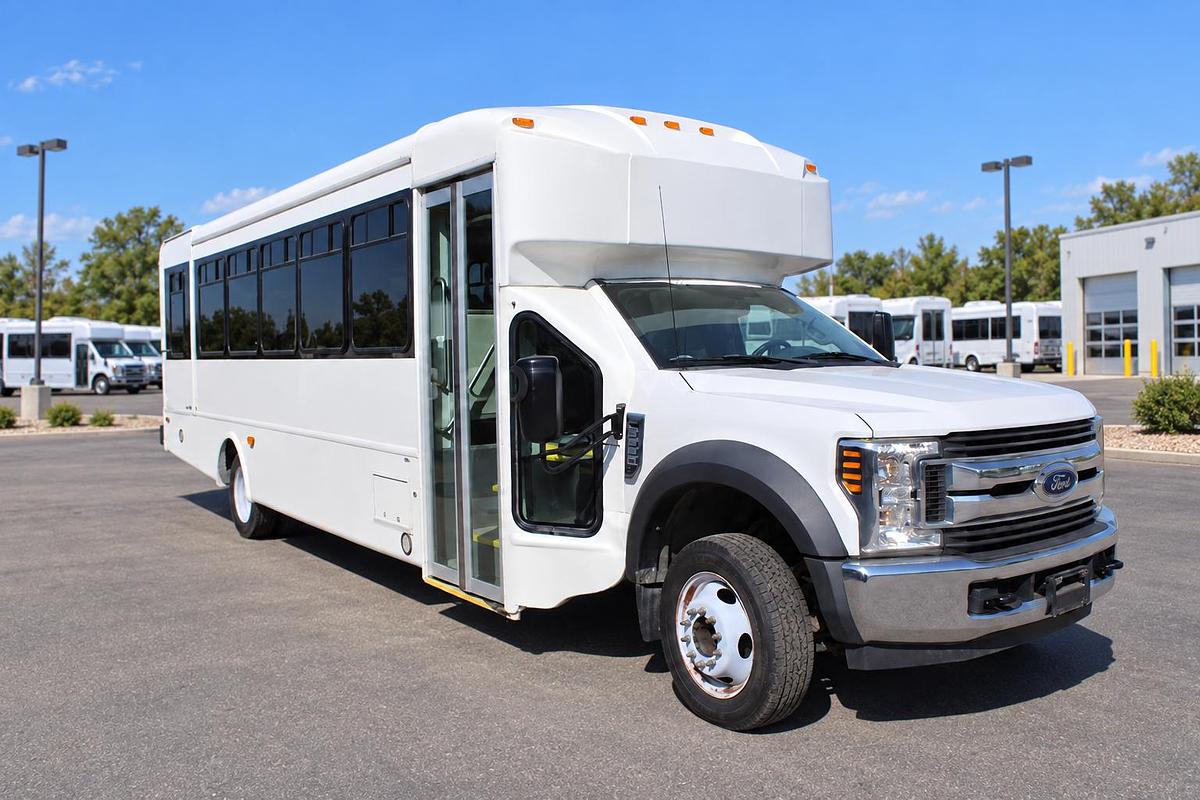
2019 Ford F-550 Glaval 24/10 Wheelchair Shuttle Bus, $76,990. For high wheelchair demand, this Glaval-bodied F-550 has folding seats that can be set up for ambulatory riders, wheelchair riders or a mix, with up to 10 wheelchair positions when configured for it. It has a 6.8L V10 gas engine, 19,500 miles, and a CARFAX showing one owner with no reported accidents. View the 2019 F-550 Glaval 24/10 listing.
Frequently Asked Questions
Is a Braun lift better than a Ricon lift? Both brands are common on commercial shuttle buses. Condition and maintenance history matter far more than the name on the data plate.
Can I check a wheelchair lift during a remote purchase? Yes. On a FaceTime walkaround, ask the seller to cycle the lift three times, test the interlocks, show the pump fluid and demonstrate the manual backup on camera. We're glad to do this for any bus we sell.
What does a lift interlock do? It keeps the bus from moving while the lift is deployed, and keeps the lift from deploying unless the bus is secured, usually in park. Federal ADA vehicle standards require it on lift-equipped buses covered by those rules.
Get a Lift-Checked Bus Delivered
Want to see a lift cycled and tested before you buy? Call or text Manny at (516) 852-2748. We source rust-free buses nationwide, offer financing, deliver anywhere in the U.S., and will walk you through any bus, lift included, on FaceTime. We're open Monday to Friday, 9 to 5, with online inquiries 24/7.
Sources
- 49 CFR 38.23, Mobility aid accessibility (lifts and ramps), Cornell LII
- 49 CFR 37.163, Keeping vehicle lifts in operative condition, Cornell LII
- NHTSA interpretation on FMVSS 403 and 404 platform lifts