
Reconditioned Small Transit Buses: A Buyer's Guide for Agencies and Paratransit
Looking for used transit buses for sale? The buses we sell are reconditioned small transit buses: cutaway shuttle buses and wheelchair vans built for community transit, paratransit, NEMT and campus routes, inspected and serviced before they leave us. For most small programs, a reconditioned cutaway on a Ford chassis gives you a lift-equipped, transit-style bus for far less than a new one, with parts any commercial shop can get.
This guide covers what "transit bus" means for a small operation, how to tell CDL from non-CDL, what to check on an ex-fleet bus, and three buses on our lot right now. You can also compare body styles on our types of shuttle buses page or browse all current listings.
What a "Transit Bus" Means for a Small Program
When people hear "transit bus," they picture a 40-foot city bus. Most of the counties, nonprofits, senior programs and paratransit contractors we talk to need something smaller: a cutaway shuttle bus (a bus body built on a Ford E-350, E-450 or F-550 chassis) or a Ford Transit with a wheelchair lift.
These buses do the same job on a smaller scale: fixed routes in a small town, door-to-door trips for seniors and riders with disabilities, campus circulators and employee shuttles. They fit in a standard service bay, run on gas or CNG, and can be serviced at an ordinary truck shop.
Light-Duty Cutaways vs. Heavy-Duty City Buses
The Federal Transit Administration rates transit vehicles by how long they are built to last. Under the minimum useful life standards in FTA Circular 5010 (as summarized by Virginia's DRPT), a light-duty bus or van is rated for 4 years or 100,000 miles, a medium light-duty bus for 5 years or 150,000 miles, a medium-duty bus for 7 years or 200,000 miles, and a large heavy-duty bus for 12 years or 500,000 miles.
What that means for a buyer:
- A heavy-duty city bus is built for many years of all-day service, but it needs a CDL driver, a large garage and a diesel shop.
- A cutaway costs far less to buy and run, and many are non-CDL. The trade-off is a shorter design life, so the condition of the specific bus matters more than its model year.
- A light-duty bus can rack up its rated miles in a few years of fleet service. Check the odometer and service history, not just the year.
CDL or Non-CDL: Count the Seats
Under federal rules, one kind of commercial motor vehicle that needs a CDL driver is a vehicle designed to transport 16 or more passengers, including the driver. FMCSA guidance says "designed to transport" counts only designated seats, not room for standing passengers. A bus with 15 or fewer seats counting the driver stays under that line; a 24-passenger bus is over it. States can add their own rules, so check with your DMV before you hire drivers.
When you see a layout like 13/2, the first number is the most passengers the bus seats and the second is the most wheelchair positions. Seats fold up for wheelchairs, so it carries fewer passengers when wheelchairs are aboard. Our non-CDL shuttle bus capacity guide walks through the common layouts.
What to Check on an Ex-Fleet Bus
- Lift and securement. Cycle the lift several times, look over the platform, and make sure the securement straps and floor tracks are all there. Our wheelchair lift inspection guide has a full checklist.
- Service history. One-owner, fleet-maintained buses often come with maintenance records. Ask for them.
- Rust. A bus from a salt state can look clean on top and be corroded underneath. Southern buses and composite bodies like Diamond Coach hold up better.
- Fuel. CNG can lower fuel costs, but only if there is a CNG station on your routes. Ask about the tank inspection history.
- Seating layout. Perimeter seating and grab rails speed up boarding on frequent-stop routes. Forward-facing seats with belts suit longer trips.
Every bus we own goes through our inspection and reconditioning process before delivery, and Manny personally inspects and test-drives it before it leaves us.
Used Transit Buses for Sale? Our Reconditioned Picks Right Now
2018 Ford E-350 Diamond Coach Non-CDL 13/2 Wheelchair Shuttle Bus (Stock B1077): $59,990
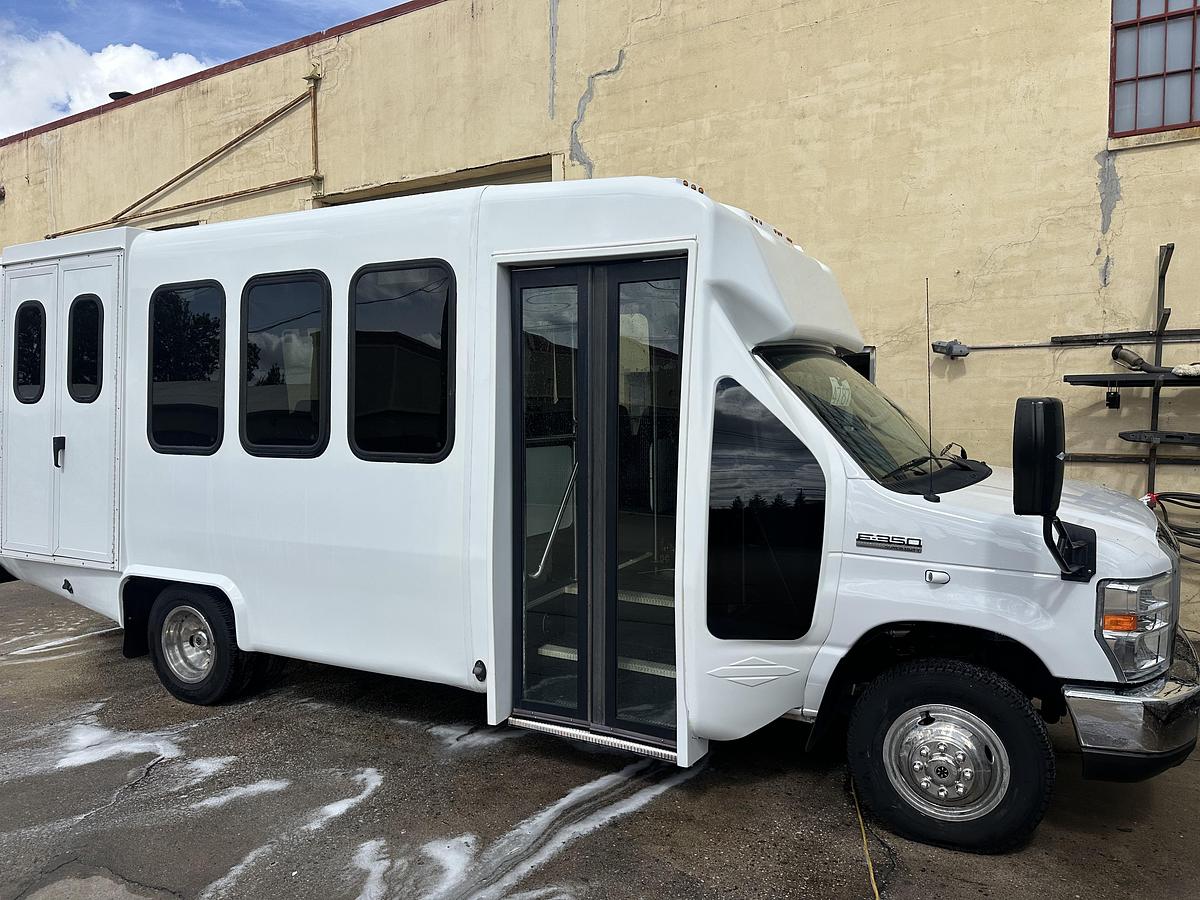
This is the most transit-style bus on our lot. B1077 has perimeter buddy seating along the walls, a wide open center aisle and overhead grab rails, so riders get on and off quickly at frequent stops, and the passenger seats have seat belts for longer runs. Up to 13 passengers, or 11 passengers plus 2 wheelchairs (seats fold up), plus driver, with a commercial wheelchair lift at the right rear (curb side). It has 42,759 actual miles, a 6.8L Triton V10 gas engine, an automatic transmission and a corrosion-resistant composite Diamond Coach body, and it spent its life outside the salt belt. Its identical mate, B1078, is also available if you want a matched pair. View the B1077 listing
2019 Ford F-550 Glaval 24/10 Wheelchair Bus for Paratransit (Stock B1080): $76,990
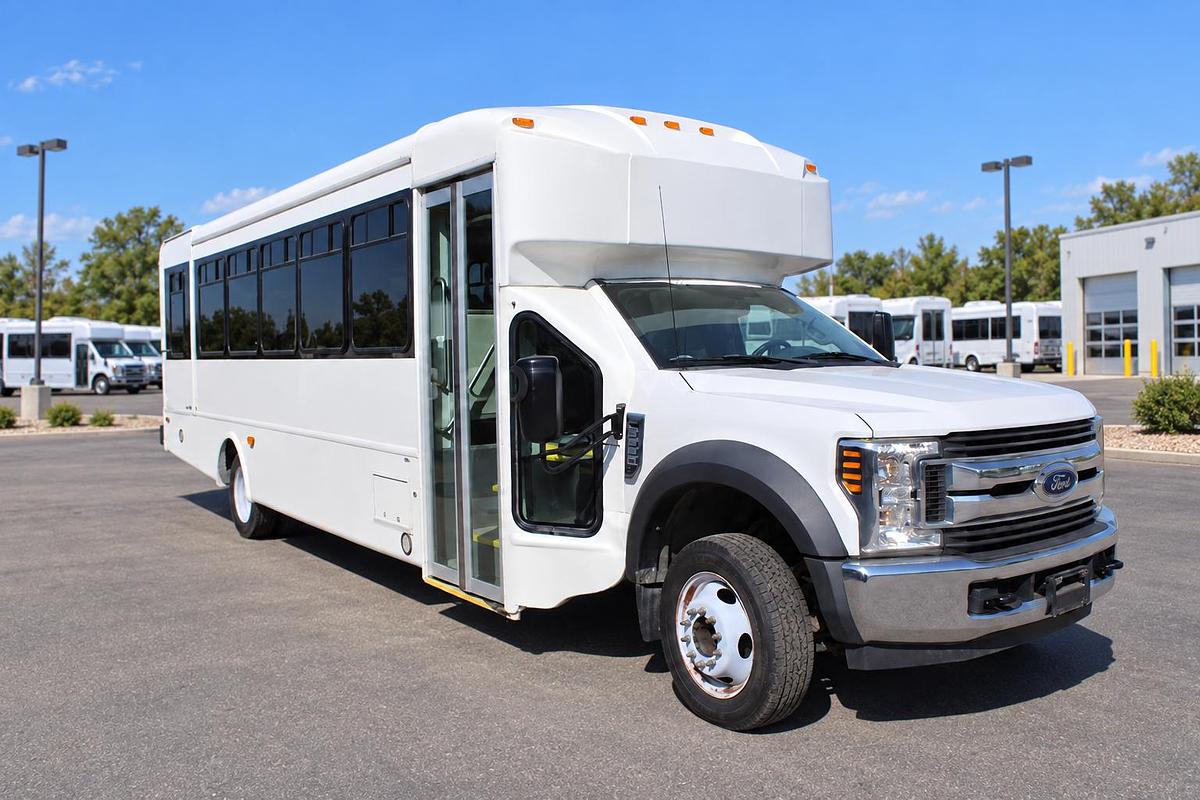
Built for bigger paratransit and NEMT routes. Up to 24 passengers or up to 10 wheelchair positions, with folding seats and a floor track system so the cabin can be set up for walking riders, wheelchair riders or a mix of both. It has only 19,500 miles, a Ford 6.8L V10 gas engine, a 6-speed automatic and a 205-inch wheelbase, and CARFAX shows one owner. With 24 passenger seats plus the driver, it is over the 16-person line, so plan on a CDL driver. View the B1080 listing
2017 Ford Transit T-350 Non-CDL CNG Wheelchair Van (Stock B1020): $21,990

A lower-cost option for door-to-door trips. This one-owner Transit was maintained by a municipality, is accident-free with a clean title, and has 71,500 miles. Up to 8 passengers or up to 2 wheelchair positions, with a Braun wheelchair lift, Q'Straint automatic wheelchair retractors, front and rear A/C with a rear heater, an electric passenger door and a rearview camera. It runs on CNG with a 3.7L V6 and an automatic transmission, and it is at our Huntington, NY lot. View the B1020 listing
See everything in stock on our listings page.
Frequently Asked Questions
Do you sell full-size 40-foot city transit buses? We focus on small transit buses: cutaway shuttle buses and wheelchair vans. If you need something specific, call us and we'll tell you whether we can source it.
Can a reconditioned bus work for paratransit or ADA service? Many of our buses come with wheelchair lifts and securement, including the 13/2 and 24/10 buses above. Requirements depend on your state and funding source, so confirm yours first and we'll help you match a bus to them.
Can I see the bus before I buy? Yes. We do live FaceTime walkarounds, and independent inspections are always welcome. We deliver anywhere in the U.S., and financing options are available.
Talk to Us About Your Route
Tell us how many riders you carry, how many use wheelchairs and whether your drivers have CDLs, and we'll point you to the right bus. Call or text Manny at (516) 852-2748 to set up a FaceTime walkaround. We deliver anywhere in the U.S. Office hours are Monday to Friday, 9 to 5, and online inquiries are welcome 24/7.
Sources
- FMCSA, CDL guidance: vehicles "designed to transport" 16 or more passengers
- Virginia DRPT, Minimum Asset Useful Life Standards for FTA Grants