
Gas vs Diesel vs CNG Shuttle Buses: Which Fuel Fits Your Fleet?
Choosing between a gas vs diesel shuttle bus, or a CNG one, comes down to three things: what fuel costs where you run, how many miles you drive a year, and who will service the bus. For most churches, senior communities and NEMT operators driving local routes, a gas bus is the simplest, lowest-cost choice. Diesel earns its keep on long, heavy miles, and CNG makes sense when you have a natural gas station on your route.
Below we walk through each fuel in plain terms, then show three reconditioned buses on our lot right now: one gas, one diesel and one CNG.
Gas vs Diesel Shuttle Bus: The Quick Answer
Most small and mid-size shuttle buses on the road today run on gasoline, and there is a simple reason. Ford stopped offering a diesel in its E-Series chassis after the 2010 model year, when the 6.0L Power Stroke was dropped with no replacement (Diesel Army). Since then, almost every Ford E-350 and E-450 shuttle bus has been gas-powered.
So if you are shopping for a 12 to 24 passenger bus built in the last fifteen years, you will see mostly gas buses, a smaller number of diesel buses on Chevrolet, GMC and Ford F-550 chassis, and a few CNG conversions.
- Gas: typical buyer: churches, senior living, NEMT, hotels. Fuel price (U.S. average, July 2026): $3.84 per gallon. Service: any truck shop. Extra upkeep: none special.
- Diesel: typical buyer: high-mileage routes, heavier loads. Fuel price (U.S. average, July 2026): $4.86 per gallon. Service: diesel-qualified shop. Extra upkeep: diesel exhaust system care.
- CNG: typical buyer: fleets with a CNG station nearby. Fuel price (U.S. average, July 2026): $3.10 per gasoline-gallon equivalent. Service: shop that works on natural gas systems. Extra upkeep: fuel tank inspections and expiration dates.
Fuel prices are national averages from the U.S. Department of Energy's Alternative Fuel Price Report, July 2026. Prices in your area will differ.
Gas Shuttle Buses: Simple, Common and Easy to Service
A gas engine is the default for a reason. Parts are everywhere, nearly any truck or fleet shop can work on it, and it starts easily in cold weather. The Ford 6.8L V10 found in many E-450 buses, and the 7.3L gas V8 Ford introduced in the 2021 E-Series (Ford), both have long track records in shuttle work.
The trade-off is fuel economy. A gas bus will usually burn more gallons than a comparable diesel. If your bus runs Sunday services, weekday senior outings or local medical trips, that gap rarely adds up to much over a year, and the lower purchase price and simpler upkeep usually win.
Diesel Shuttle Buses: Built for Long, Heavy Miles
Diesel engines deliver strong pulling power and better miles per gallon, which matters when a bus runs long daily routes or highway trips with a full load. In July 2026, diesel cost about $4.32 per gasoline-gallon equivalent against $3.84 for gasoline (AFDC), so the savings come from using fewer gallons, not from cheaper fuel.
Plan for diesel-specific care. Modern diesels have emissions equipment that needs the right fluids and a shop that knows the system. If you have a good diesel mechanic nearby and you drive a lot of miles, a diesel bus can be a very good fit.
CNG Shuttle Buses: Low Fuel Cost, If You Can Fill Up
Compressed natural gas (CNG) was the cheapest of the three fuels in the July 2026 report, at $3.10 per gasoline-gallon equivalent (AFDC). That makes CNG attractive for fleets that run the same routes every day and have a fueling station on the way.
CNG tanks come with rules you should know before you buy:
- Inspections. Federal rules require each CNG tank to carry a label saying it should be visually inspected at least every 36 months or 36,000 miles, whichever comes first, on vehicles rated 10,000 lb GVWR or less, and at least every 12 months on heavier vehicles, plus after any accident or fire (49 CFR 571.304).
- Expiration date. Each tank is labeled "Do Not Use After" a set month and year. CNG tanks typically last 15 to 20 years and cannot be requalified, so an expired tank must be replaced (AFDC).
- Fueling. Before you buy, check for a CNG station near your route on the AFDC station locator.
Always ask for the tank's expiration date on any CNG bus. We are glad to read it off the label for you on a FaceTime walkaround.
What About the CDL?
Fuel type does not change the license rule. Under federal rules, a vehicle designed to carry 16 or more people including the driver is a commercial motor vehicle, and the driver needs a CDL with a passenger endorsement (FMCSA). Gas, diesel or CNG, a bus that seats 15 passengers or fewer plus the driver is the non-CDL range most of our buyers want. See our non-CDL shuttle buses for sale and our guide to non-CDL shuttle buses.
Gas, Diesel and CNG Shuttle Buses for Sale Now
Here are three reconditioned buses on our lot today, one for each fuel. See everything in stock on our listings page, or compare body styles on our types of shuttle buses page.
Gas: 2017 Ford E-450 16/2 Wheelchair Shuttle Bus
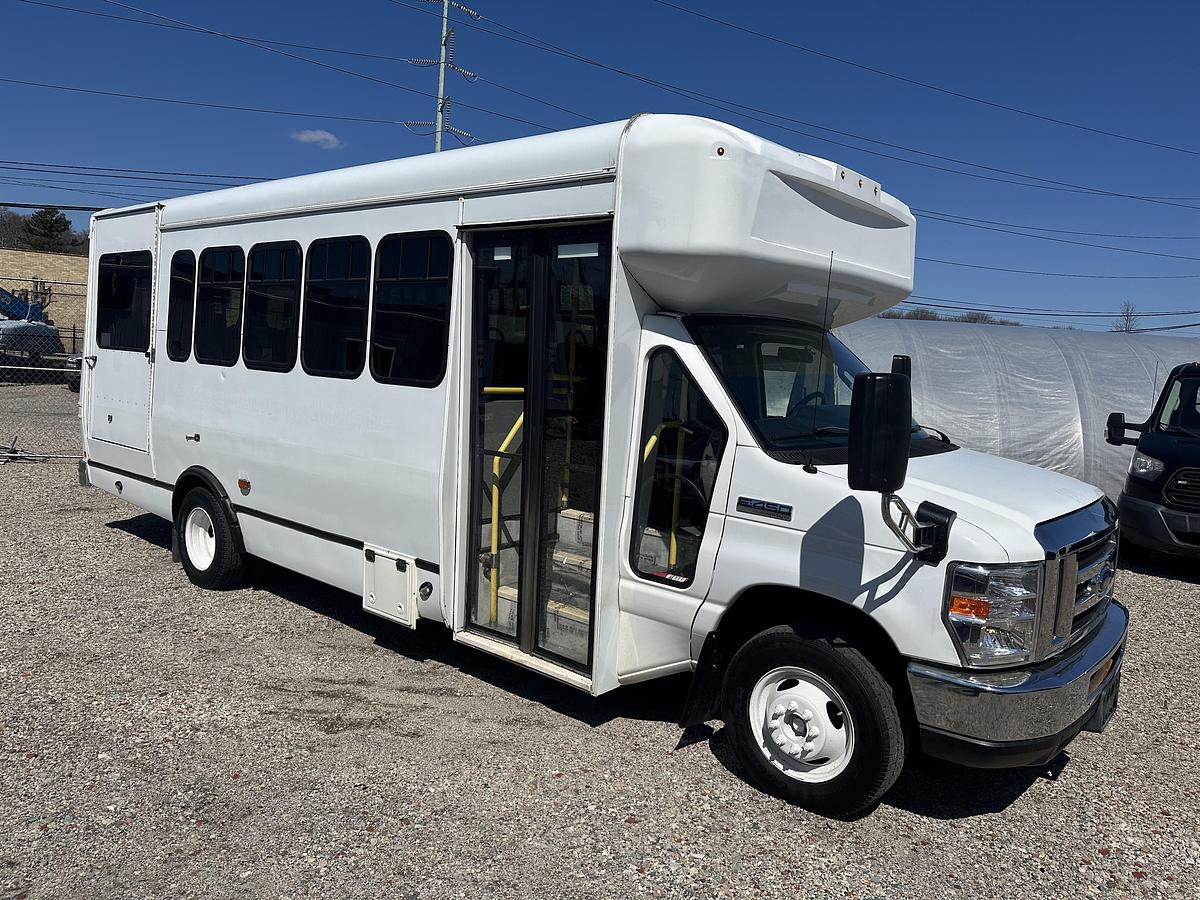
This E-450 runs the 6.8L Triton V10 gas engine with an automatic transmission and 96,500 miles. It carries up to 16 passengers, or 12 passengers plus 2 wheelchair positions (seats fold up), plus driver, with a BraunAbility lift, Q'Straint retractors, front and rear A/C and a backup camera. At 16 passengers plus driver it needs a CDL with passenger endorsement. A good fit for a church or senior community that wants one larger bus. $34,000. View the 2017 Ford E-450 16/2
Diesel: 2016 Chevrolet 3500 Non-CDL 12 Passenger Shuttle Bus

A Duramax 6.6L turbo diesel with an automatic transmission and only 47,098 miles. It seats 12 passengers plus driver (no wheelchair lift), so no CDL is needed. Front and rear A/C, a diesel auxiliary heater and an electric passenger door make it a comfortable year-round shuttle for a hotel, church group or employee route. $34,990. View the 2016 Chevrolet 3500 diesel
CNG: 2017 Ford Transit T-350 Non-CDL 8/2 Wheelchair Van

This Transit runs on compressed natural gas with a 3.7L V6, an automatic transmission and 71,500 miles. It carries up to 8 passengers, or 4 passengers plus 2 wheelchair positions (seats fold up), plus driver, with a Braun lift and Q'Straint automatic retractors. A strong choice for an NEMT operator with CNG fueling nearby. $21,990. View the 2017 Ford Transit T-350 CNG
FAQ
Is a gas or diesel shuttle bus cheaper to run? It depends on your miles. Diesel uses fewer gallons but cost more per gallon in July 2026. For local routes, gas is usually cheaper overall once you count purchase price and service. For long daily highway miles, diesel can come out ahead.
Do CNG buses need special inspections? Yes. CNG tanks must be labeled for regular visual inspection (every 36 months or 36,000 miles on lighter vehicles, every 12 months on heavier ones) and carry an expiration date, after which the tank must be replaced.
Can I get a non-CDL bus in any fuel type? Yes. The CDL rule depends on seating, not fuel. A bus designed for 15 passengers or fewer plus the driver stays in the non-CDL range, whether it runs on gas, diesel or CNG.
Ready to Find Your Bus?
Call or text (516) 852-2748. We deliver anywhere in the U.S. and do FaceTime walkarounds so you can see the engine, lift and interior before you buy. Browse all reconditioned shuttle buses for sale, or read why the Ford E-450 is still the king of shuttle buses.
Sources
- U.S. DOE, Clean Cities and Communities Alternative Fuel Price Report, July 2026
- U.S. DOE AFDC, Natural Gas Vehicle Cylinder Safety
- 49 CFR 571.304, FMVSS 304 Compressed Natural Gas Fuel Container Integrity
- FMCSA, Definition of a CMV designed to transport 16 or more passengers
- Ford Media, 2021 E-Series
- Diesel Army, The 2004 to 2010 6.0L Power Stroke E-Series